Battery Backup Sump Pump Installation in Montreal — Protect Your Basement When Power Fails
Battery backup sump systems that keep pumping during power outages and heavy rainfall.
4.8 / 5 GoogleUrgence 24/7Montreal et region
+110 avis verifies
Your primary sump pump runs on electricity. That's exactly the problem — the moments when you need it most, during the heaviest storms and worst weather events, are the same moments when Hydro-Québec outages are most likely to cut your power. A battery backup sump pump keeps running when the power goes out, automatically and without any action from you. Plomberie 5 Étoiles installs battery backup systems across Montreal, Laval, the South Shore, and the North Shore — with same-day availability in most cases.
Well done guys, they've earned their 5 stars
My kitchen sink wasn't flushing despite the underneath pipes being clean. My basement toilet was out of order. I called them at 9:30am, the man clearly explained the fees wit…
Great camera inspection, even earlier than scheduled. Very friendly and gave clear explanations of the work. I truly recommend them. My plumber was Zoiubir. Thanks to Alex.
An electrical sump pump will protect your basement most of the time but mechanical failures or power failures lead to significant basement water problems. If your sump pump system has no battery backup sump pump you are in risk of flooding as the power failures most often occur when there are heavy rainstorms. When waters are rising and rains are at their worst, you'll be glad there's a battery backup sump pump available to kick in and handle the water the primary sump pump couldn't handle.
Why Power Outages and Sump Pump Failure Happen at the Worst Possible Time
The mechanics of it are straightforward: severe weather is the leading cause of basement flooding. Severe weather is also the leading cause of power outages. These two problems reliably coincide. The ice storms of recent Quebec winters — which left hundreds of thousands of Hydro-Québec customers without power for days — happened during the same period that snowmelt and rain were putting maximum pressure on basement drainage systems. Without backup power, a sump pump that loses electricity during one of these events will sit idle while water rises in the pit and eventually enters the basement.
Beyond power failures, your primary sump pump can also fail from:
Mechanical breakdown — float switches jam, impellers wear out, motors fail. Sump pumps are mechanical devices with a service life typically between 7–10 years
Overwhelmed capacity — during extreme rainfall or rapid spring snowmelt in the Montreal area, a single pump sometimes can't move water fast enough. A backup system adds pumping capacity when the primary pump falls behind
Float switch failure — one of the most common single-point failures, where the switch mechanism gets stuck and the pump simply doesn't activate
Tripped circuit breaker or blown fuse — not a storm-related cause, but it produces the same result: no power, no pumping
A battery backup sump pump addresses all of these scenarios. It activates automatically the moment water in the pit rises above the primary pump's operating level — whether due to a power failure, a mechanical issue, or overflow conditions.
What Happens During a Battery Backup Sump Pump Installation
Most battery backup sump pump installations in a Montreal-area home take 1–3 hours. Here's what to expect:
1. Assessment of your existing system. We inspect your current sump pump, pit, and discharge pipe. We confirm the pit dimensions, the condition of the existing pump, the discharge pipe routing, and whether the existing check valve is functional. If the primary pump is aging, we'll advise on replacing it at the same time.
2. System selection. We recommend the appropriate backup pump model based on your pit size, typical water volume, the age of your primary pump, and your preference for battery vs. combo setup.
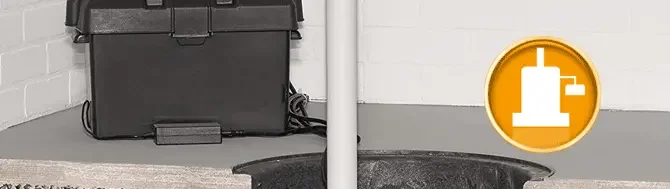
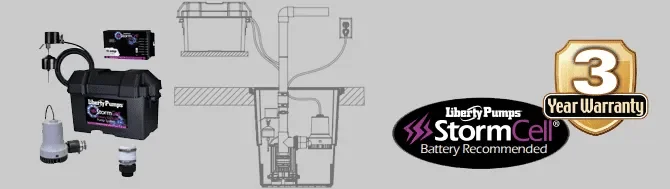
3. Pump and battery installation. The backup pump is installed in the pit alongside (or replacing) the primary pump. The battery unit and control box are mounted nearby — typically on the basement wall within reach of a standard electrical outlet for the trickle charger.
4. Float switch calibration. The backup pump's float switch is set at the correct height relative to the primary pump's switch — high enough that the backup doesn't interfere with normal primary pump operation, but low enough to activate promptly when the primary fails.
5. Discharge pipe connection. The backup pump connects to the same discharge pipe as the primary pump (with proper check valves to prevent backflow between the two systems).
6. Testing. We simulate a failure by interrupting the primary pump and confirming the backup activates at the correct water level. We verify the alarm system, test the battery charge, and confirm all connections are secure.
7. Walkthrough. We explain how to test the system yourself, what the alarms mean, when to expect battery replacement, and what maintenance to perform annually.
Battery Backup Sump Pumps in Montreal and Quebec — Why This Matters Here
Montreal's climate and geography make battery backup systems more relevant here than in many other Canadian cities.
Hydro-Québec power outages during storms. Quebec's ice storm history is well documented — the 1998 ice storm remains one of the costliest natural disasters in Canadian history, but significant outages affecting hundreds of thousands of customers have occurred repeatedly since. Spring thunderstorms and freezing rain events regularly knock out power across the island and surrounding regions for hours at a time. In almost every case, these outages coincide with maximum runoff and sump pump demand.
Spring snowmelt — the highest-risk season. The Montreal area receives significant snowfall that accumulates through winter. When temperatures rise in late March and April, the resulting melt — combined with spring rainfall — creates peak drainage demand across the region. This is the period when both primary pump failures and power outages are most consequential. A battery backup installed before the spring season is a practical investment, not a precautionary one.
Laval and South Shore flood risk. Homes in Laval, La Prairie, Châteauguay, Candiac, and the Richelieu River corridor sit on terrain with a higher seasonal water table. The flooding events of 2017 and 2019 demonstrated that when municipal sewer systems are overwhelmed during extreme precipitation, homes without adequate backup protection face significant damage. A battery backup sump pump is typically paired with a backwater valve installation for complete flood protection in these areas.
Finished basements. Montreal homeowners have invested heavily in finishing basements as living space, home offices, and secondary suites. The cost of a battery backup installation is a fraction of the cost of remediating a flooded finished basement — and the disruption of a flood in a finished space is far greater than in an unfinished utility basement.
Any of these situations warrants serious consideration:
Your primary sump pump is more than 7 years old. The average service life is 7–10 years. Older pumps are more likely to fail mechanically.
Your primary pump runs frequently. High cycling frequency is a sign that your pit fills quickly — during extreme events, a single pump may not keep up.
Your basement is finished. The cost consequence of flooding is significantly higher.
You've had water in your basement before. Past flooding is the strongest predictor of future flooding.
You travel regularly or are away from home for extended periods. A backup system with an alarm — or a smart monitoring unit — provides protection when you can't respond personally.
You live in Laval, the South Shore, or a Montreal neighbourhood prone to basement flooding. Geographic risk is a real factor, especially near the St. Lawrence and Richelieu floodplains.
You don't have a generator, or your generator requires manual startup. A battery backup activates instantly and automatically, without any human intervention.
Battery Backup Sump Pump Maintenance
A backup system is only as reliable as its maintenance. Here's what to do:
Monthly:
Check that the backup pump's control unit shows a green/normal status indicator
Confirm the battery charger is plugged in and charging correctly
Every 3–6 months:
Test the backup pump manually by lifting the float switch by hand (or unplugging the primary pump temporarily) to confirm the backup activates
Inspect the battery terminals for corrosion — clean with a wire brush if needed
Check that the backup pump's discharge connection and check valve are clear and functional
Annually:
Have a plumber inspect the full system — battery condition, float switch calibration, discharge routing, and pump performance
Check the battery's charge retention. A battery that doesn't hold a full charge for more than a few days should be replaced
Every 3–5 years:
Replace the deep-cycle battery. Even well-maintained batteries lose capacity over time. Battery replacement is a low-cost maintenance step that preserves your system's full protection.
Before each spring season:
Test the backup pump as above
Confirm the pit is clear of debris
Ensure the discharge pipe exterior outlet is clear of ice and debris from winter
Battery Backup Sump Pump vs. Generator — What's the Difference?
This is one of the most common questions we get, and the answer is: they solve different problems and are best used together.
Battery Backup Sump Pump
Generator
Activation
Instant, automatic
Requires manual startup (unless automatic transfer switch)
Setup required during outage
None
Must be started and fuelled
Powers other appliances
No — sump pump only
Yes — multiple circuits
Runtime
Hours (based on water volume)
As long as fuel supply lasts
Indoor safe
Yes
No — requires outdoor operation
Best for
Immediate automatic protection
Extended multi-day outages
The practical recommendation for Montreal homeowners: A battery backup sump pump handles the first hours of any outage automatically and instantly — the most critical window. If you also have a generator, it takes over for longer outages once it's running. If you don't have a generator, the battery backup provides the protection you need for most weather-related outage scenarios.
15+ years installing sump systems across Montreal, Laval, and the South Shore. We've worked in homes throughout the highest-risk flood zones in the greater Montreal area — including the Laval bungalow belt, the South Shore's Richelieu corridor, and finished basements across the island. We know which systems hold up and which configurations fail.
We carry equipment on the truck. Most installations are completed same-day without ordering parts.
CAA-Québec recommended for 10+ years. Verified quality, every year.
4.8 stars on Google, 150+ verified reviews. Our reviews reflect real jobs done well — camera inspections, sump pump installations, drain emergencies.
Transparent pricing. You receive a confirmed price before we start. No surprises at invoice time.
RBQ #5663-4538-01 · CMMTQ Member · Fully insured. All work is code-compliant and covered.
A sump pump battery backup system is designed to automatically take over when your main sump pump stops working, such as during a power outage or mechanical failure. It continues to remove water and helps protect your basement from flooding.
A backup system is essential because your main pump can fail at any time due to power outages, heavy water flow, or mechanical issues. A battery backup provides an extra layer of protection and helps prevent costly water damage.
Yes. The battery backup allows the system to operate even when there is no electricity, which is critical since power outages often occur during heavy storms.
The duration depends on the battery capacity and how much water needs to be pumped. In general, a fully charged battery can run for several hours and pump a significant amount of water.
Yes. The system activates automatically when the water level rises and the main pump is not functioning. No manual intervention is required.
Yes, especially if:
Your basement is finished
You’ve had water issues before
You live in a high-risk area
You want peace of mind during storms
Without a backup system, a simple power outage can quickly lead to flooding.
Main sump pump: runs on electricity during normal conditions
Backup pump: runs on battery and takes over if the main pump fails
Both systems work together to provide maximum protection.
Your pump runs frequently
Your system is aging
You’ve experienced flooding or water issues
You currently have no protection during power outages
Yes. The battery should be checked regularly and typically replaced every few years to ensure reliable performance.
Yes. During heavy rain or high water volume, the backup system can assist the main pump if it becomes overwhelmed.
 4.8 / 5 Google
 +110 avis verifies